
Linda monclure
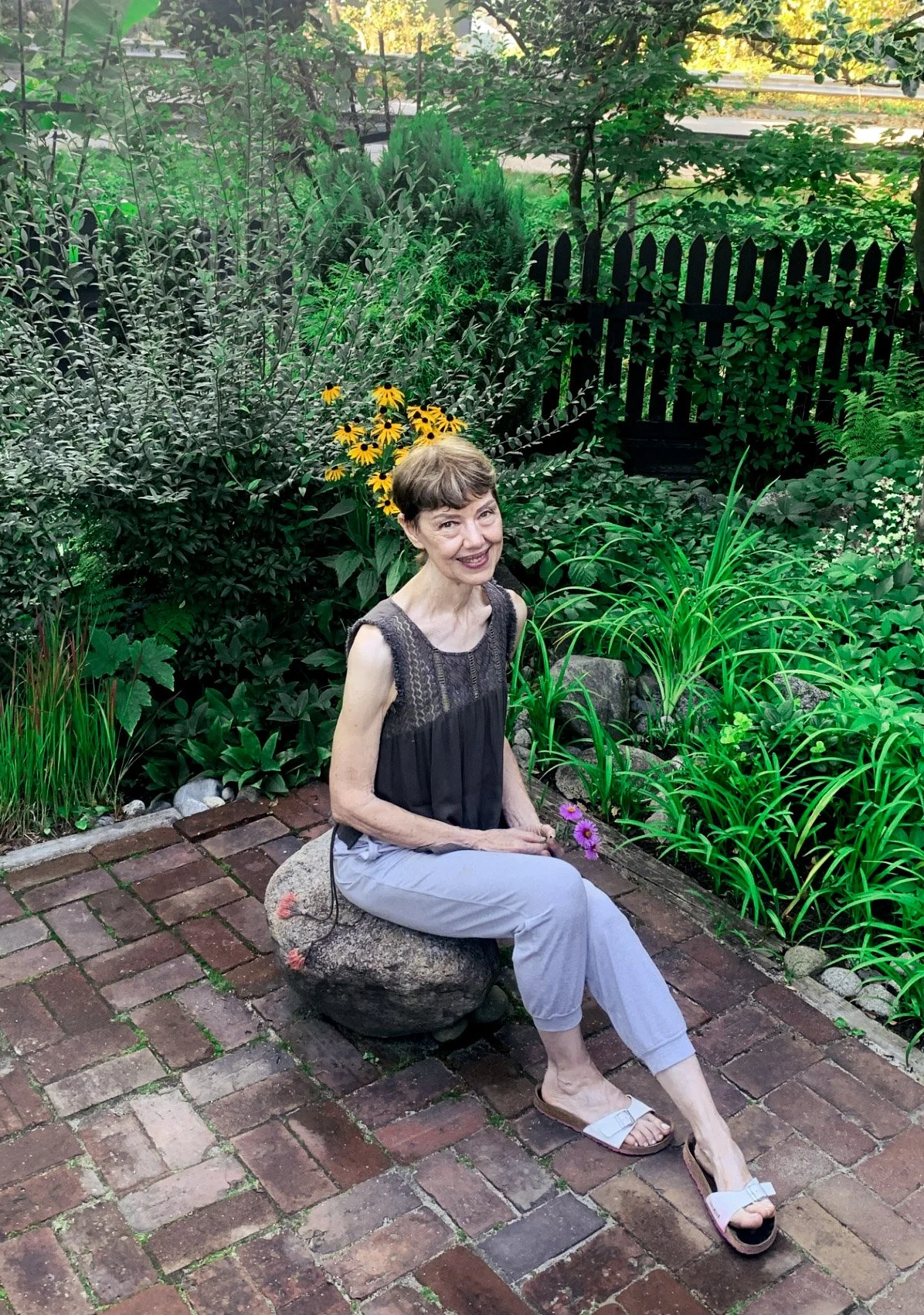
Port Moody Heritage Society Member and Museum Gardening Volunteer
In that moment, the parallel was so striking, I turned to the others and said, “We should transform this corner into a Meditation Garden, a place to pause, to stroll, meditate, contemplate.” The immediate concern was the adjacent traffic going by. I stated my belief: “It’s in spite of the busy road, we can carve out a quiet garden space.” It was that spring and summer that the transformation began to take form.
What would you like people to take away from the garden?
In short, a sensory experience… The garden provides the conditions for people to get out of their heads and into their senses: to see with a wide lens, to hear sounds near and far, to feel the earth they walk upon, to rub their fingers along the bark of a tree, to smell a plant’s unique fragrance, in other words, to be in relation with nature where the separation is lifted, revealing the desire to protect the Earth, remembering that we are part of the Earth, not separate.
Here’s something people can do in the garden to stimulate the olfactory sense, the sense of smell in the upper nose:
Place a sprig of lavender from the top of the stem between your thumb and other fingers and rub your fingers back & forth a few times. Then smell the fragrance on your fingertips. You’ll discover the soft, calming scent of lavender which has been found to decrease cortisol, the stress hormone.
Throughout the years the McKnight Centennial Trench was installed on the grounds (2014–2023), the Meditation Garden was its closest companion. They were situated back to back, on the west side. Together, they represented War & Peace.
The garden has outlived the trench. The only remains is the plaque on the garden gate, reading “Peace”. I would like to think that when people visit the garden...
What are the plants or elements in the garden that are especially meaningful to you?
The topography, the physical features of the land the garden is on - its rocky nature - its proximity to the inlet - its surface that is not always level - it goes up & down - it’s more interesting.
Sitting on the bench, at the entryway, the space feels to me like a sunken living room in the open air, with the platform above looking down on it. The structured path turns and gives way to a surprising wide-open extension where different pathways take you to different destinations. It has a less-structured plan that invites movement, play, curiosity…
I visualize a musician standing on the deck of the north side, playing the deep, long drone sounds of the didgeridoo while people below slowly walk on-by in meditation. “It becomes a ceremony.”
What does working in the garden mean to you, personally?
I resonate strongly with the earth element. Feeling close to the earth represents to me stability, foundation, roots, so it’s not surprising that I have gravitated to gardening where there’s a physical relationship with the earth: digging, planting, trimming, clearing, just enjoying being outdoors, creating something meaningful and sharing space with the crows and all their mischief.
There’s the aesthetic element too. I love to create spaces that exude a certain harmony and simplicity. Before the garden was created, I studied and practiced the art of Ikebana, Japanese flower arranging. Throughout the early 2000’s, my creative project was to install my floral art pieces in public spaces throughout the Tri-Cities including the Port Moody Museum.
My interest was in seeing how the infusion of a fresh floral arrangement affected the space it was placed in and then, how it affected the people who frequented the space. I can ask the same questions of the Meditation Garden on the Museum grounds. For a long time I regarded the garden as my public art project.
I have a relationship with the garden. I’m one of its caretakers. Like any meaningful relationship, it requires consistency, dedication and devotion. Those are the values I try to live up to.
What do you notice when you spend quiet time working in the garden?
I notice the way the light lands and makes shadows on the ground and I notice when an earthworm emerges from the ground and slithers around.
I notice the hum of the traffic, the sounds of the crows cawing and a visitor arriving.
I notice when a plant looks thirsty, when a holly leaf falls & hits the ground and how I lose complete track of time.
I notice cracked open chestnuts lying on the ground and how the wild poppies multiply and expand.
I notice the glistening leaves on the birch tree and beyond — just when the “Golden Hour” begins, before 6 pm, the lighting feels magical, sublime, I notice that I don’t want to be anywhere else at this time.
If you had to describe the Meditation Garden in just a few words, what would they be?
A quiet place
for one’s heart
to rest
A handful of
soil
ready to sow
a seed of
peace
within the hearts
of all who
seek
to breathe in
peace and
harmony
Do you have a favourite local plant?
Yes, my favourite local plant is the wild violet. We see it in the Meditation Gdn in springtime. It pops up in little patches at edges of beds & paths. It has deep purple/blue flowers and dainty heart-shaped leaves that grow in dense, little clusters.
It represents royalty, introspection and spirituality, and its purple flowers symbolize sincerity and intuition.
How did the idea for the Meditation Garden begin?
One fine spring day in the year 2014, we were taking a leisurely walk together around the grounds. There was Jim Millar (former Executive Director), Mary Anne Cooper (former Board member) and myself (longtime volunteer), just back from a leave of absence. Little did I know, I was walking into a big, long-lasting project.
When we came to the northwest corner, a part of the grounds I had never really explored, used then for storage - bricks, soil, compost - my gaze suddenly became fixed on the big flat rock, sitting alone on the red brick floor under the tall holly tree. The thought that struck my mind was that of the Buddha who had attained enlightenment while meditating under the Bodhi tree in an Indian village around 528 BC.

